VOICE TWO:
Cecil B. DeMille was among the very few filmmakers in Hollywood whose name appeared above the title of his movie. His name was more important to movie-goers than the names of the stars in the movie. DeMille’s movies were known to be big productions. He combined a lot of action, realistic storytelling and hundreds of actors to make some of Hollywood’s best movies. He made many kinds of movies including westerns, comedies, romances and ones dealing with moral issues.
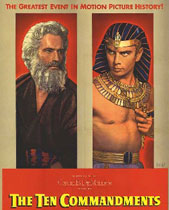
DeMille gained a great deal of fame with the kind of movie known as an epic. An epic tells a story of events that are important in history. DeMille’s epic movies were based on the settling of the American West, Roman history or stories from the Bible. His first version of the historic film “The Ten Commandments” was a huge success among silent films in nineteen twenty-three. In nineteen fifty-six, he released a new version of “The Ten Commandments” to include sound. It is broadcast still on American television during the Christian observance of Easter.
VOICE ONE:
Cecil B. DeMille produced and directed seventy movies. In nineteen forty-nine he received a special Academy Award for “thirty-seven years of brilliant showmanship.” He died of heart failure in nineteen fifty-nine.
One of DeMille’s last films was “The Greatest Show on Earth.” It won the Academy Award for best picture in nineteen fifty-two. It was about people who performed in the circus. Some people say it was a fitting subject because Cecil B. DeMille often was called the greatest showman in Hollywood.
VOICE TWO:
In eighteen ninety-five, a thirteen year old boy from Warsaw, Poland found his way to the United States. Samuel Goldfish was alone. He had no money. He found work as a glove maker. He continued working in the glove-making industry until he was almost thirty years old.
In nineteen thirteen, Samuel and his wife’s brother, Jesse L. Lasky, and Cecil B. DeMille formed the Jesse L. Lasky Feature Play Company. It produced the movie “Squaw Man.”
In nineteen sixteen, Goldfish started a business with Edgar Selwyn. They combined their names Goldfish and Selwyn and called the new company Goldwyn. Samuel Goldfish liked the name and changed his to Samuel Goldwyn in nineteen eighteen. The Goldwyn Company made many successful motion pictures. Yet, the company was not a financial success.
In nineteen twenty-two, Samuel Goldwyn was forced to leave the company. The Goldwyn Company then joined with Metro Pictures and Louis B. Mayer Productions to form Metro-Goldwyn-Mayer, known as MGM. Samuel Goldwyn was not part of the deal. He promised never to be a joint owner of another company. He formed his own company Samuel Goldwyn Productions.
VOICE ONE:
Samuel Goldwyn was one of the great independent producers during the “Golden Age” of Hollywood. Most of his films were successful financially and popular with critics. He insisted that his films be well made and of high quality. This became known as the “Goldwyn Touch.”
Goldwyn usually paid for his films himself. He bought the best stories and plays to be made into movies. He employed the best writers, directors and actors.
And he discovered new actors including Lucille Ball, Gary Cooper, Susan Hayward and Will Rogers.
Goldwyn was extremely independent. He had a strong desire to control every element of the production and marketing of his films. He made all decisions concerning his films including choosing directors, actors and writers. His best films include “The Little Foxes,” “The Best Years of Our Lives” and “Porgy and Bess.” His movies received many Academy Awards.
VOICE TWO:
Samuel Goldwyn was known also for his sense of humor. He created funny expressions. In Hollywood they are known as Goldwynisms. One of his most famous expressions was “Include me out.”
In nineteen forty-six, Goldwyn received the Irving Thalberg Memorial Award for his excellent movie productions during the Academy Award ceremonies that year. He died in nineteen seventy-four.
Samuel Goldwyn was in the movie business for almost sixty years. He is considered one of the most influential film producers ever.
VOICE ONE:
Louis B. Mayer began as a theater operator in Havermill, Massachusetts in nineteen-oh-seven. Over the next several years he bought more theaters. Soon he owned the largest group of theaters in New England. In nineteen seventeen, Mayer formed his own movie production company. In the early
nineteen twenties, Louis B. Mayer Pictures joined two other companies to form Metro-Goldwyn-Mayer.
Mayer was appointed vice president and general manager of Metro-Goldwyn-Mayer. He had a strong fatherly way of supervising the company and actors.
The company had some of the biggest names in show business including Judy Garland, Clark Gable, Katherine Hepburn and Elizabeth Taylor. A popular expression used at the time was MGM had “more stars than there are in heaven.” MGM produced some of the most popular movies of all time including “The Wizard of Oz,” “Gone with the Wind” and “The Philadelphia Story.”
VOICE TWO:
In the nineteen thirties and nineteen forties, Louis B. Mayer was the most powerful businessman in Hollywood. He earned more than one million two hundred thousand dollars a year. He was paid more than anyone else in the United States.
In nineteen fifty, Mayer received a special Academy Award for “excellent service to the Motion Picture industry.” He died in Hollywood, California in nineteen fifty-seven. He was seventy-two years old.
VOICE ONE:
Cecil B. DeMille, Samuel Goldwyn and Louis B. Mayer are remembered for their excellent movies and their continuing influence in the motion picture industry. They led the way for movie producers and directors of today and those still to come.
VOICE TWO:
This program was written and directed by Lawan Davis. Our studio engineer was Keith Holmes. I’m Steve Ember.
VOICE ONE:
And I’m Sarah Long. Join us again next week for PEOPLE IN AMERICA in VOA Special English.













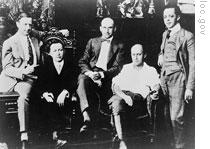 Far left, Jesse L. Lasky; center, Samuel Goldwyn; second from right, Cecil B. DeMille
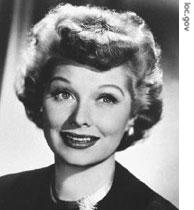 Lucille Ball
 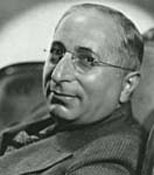 Louis B.Mayer